English

Views: 0 Author: Site Editor Publish Time: 2026-10-22 Origin: Site
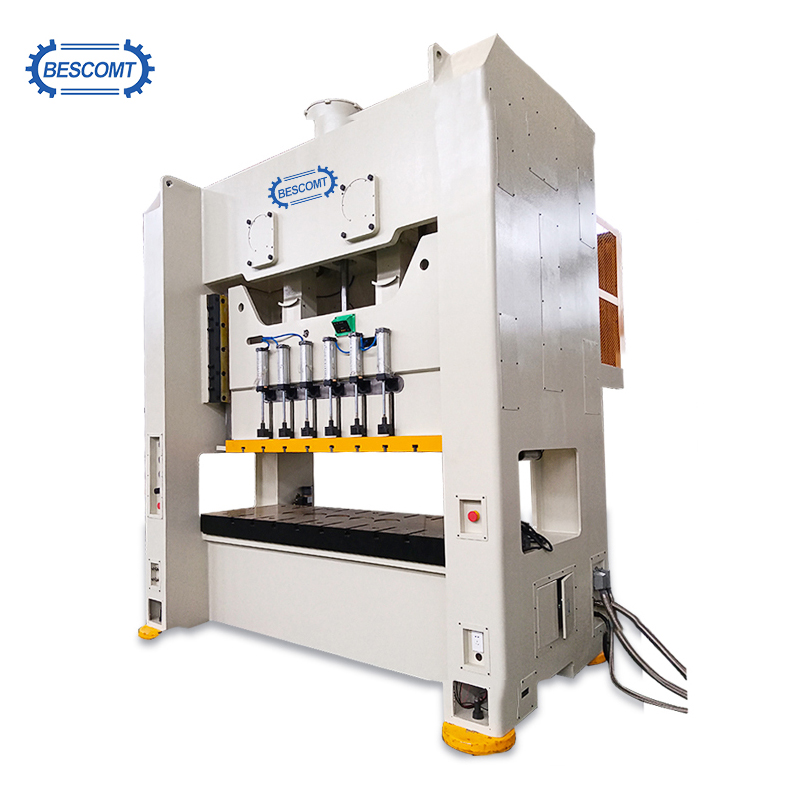
In high-volume metal stamping, relying on a single-point press for wide or multi-station dies inevitably leads to slide tipping, accelerated die wear, and unacceptable part tolerances. Manufacturers scaling up to progressive die operations or stamping wide, asymmetrical parts often face bottlenecks caused by off-center loading. Upgrading tooling without upgrading the press architecture results in high scrap rates and frequent maintenance downtime. While CNC turret punch presses serve low-volume, high-mix sheet metal fabrication, high-volume manufacturing requires the brute force and stability of a mechanical or pneumatic press to drive complex dies. Transitioning to a double point punch press distributes the tonnage across two connections, stabilizing the slide. This guide evaluates the engineering criteria, frame variations, and production scenarios that justify the capital investment in double-point architecture.
Double-point presses are mandatory for progressive die stamping and wide-bed applications where off-center loading creates destructive tipping moments on the slide.
Selecting between an open type and a closed type (H-frame) double-point press dictates the trade-off between tooling accessibility and maximum structural rigidity.
Upgrading to a double-point system extends die life significantly by minimizing angular deflection during the stamping stroke.
Partnering with a qualified power press manufacturer for a custom punch press machine ensures proper integration with automated coil feeds, transfer systems, and modern safety protocols.
Mechanical limitations become glaringly obvious when you push a single-point press beyond its intended dimensional capacity. A single connection point delivers force directly down the center of the slide. When the bed width exceeds the localized support of this single pitman, any tooling operation occurring near the outer edges of the bed creates a lever effect. This mechanical reality dictates the need for a structural upgrade to maintain operational integrity on the shop floor.
The fundamental mechanical difference lies in the drive train and connection architecture. A single-point press utilizes one pitman arm connected to a central eccentric shaft. Force transmits through this single node, radiating outward across the slide. In contrast, a double-point system features two pitmans, typically driven by a common crankshaft or synchronized twin gears. These dual connections attach to the slide at widely spaced intervals.
Distributing the driving force across two distinct points fundamentally alters the machine kinematics. Instead of acting as a single pushing point that allows the slide edges to float or deflect, the dual connections force the entire slide to descend in parallel alignment with the bolster plate. This parallel motion ensures that punch penetration remains perfectly vertical, regardless of where the actual cutting or forming takes place along the left-to-right axis of the die bed. The gibs guide the slide, but the dual pitmans provide the driving stability.
Off-center loading destroys precision stamping operations. In multi-station progressive dies, the tonnage required at station one rarely matches the tonnage required at station five. Heavy piercing on the left side and light coining on the right side shifts the center of working tonnage away from the physical center of the press bed. You cannot avoid this imbalance in complex part designs.
When a single-point press encounters this imbalance, the slide experiences tipping moments. We define these as yaw and pitch. Slide tipping causes the punches to enter the die matrix at a slight angle. Over thousands of strokes, this angular entry causes uneven punch wear, micro-chipping of the die edges, and parts that fail dimensional tolerance checks. You end up pulling the die for sharpening far more often than scheduled.
A strict engineering threshold applies here. When the left-to-right dimension of your die requires force application outside the center third of the press bed, double-point architecture transitions from an optional upgrade to a structural necessity. The dual connections counteract the tipping moment, holding the slide rigid against the asymmetrical resistance of the tooling.
Mechanical Characteristic | Single-Point Press | Double-Point Press |
|---|---|---|
Force Distribution | Centralized at a single node | Spread across two widely spaced nodes |
Slide Stability | Prone to tipping under off-center loads | Maintains strict parallel motion |
Die Wear Impact | Accelerated wear on wide dies due to angular entry | Extended die life through vertical punch penetration |
Bed Width Capacity | Limited to narrow, centralized tooling | Engineered for wide, multi-station progressive dies |
Selecting the correct structural design dictates how well the machine will integrate into your specific production environment. The two primary frame categories offer distinct advantages and trade-offs regarding rigidity, accessibility, and footprint. You must match the frame to your specific tooling and material handling requirements.
An open type double point press utilizes a C-frame structure combined with dual suspension points. The frame resembles the letter "C," leaving the front and both sides completely open and free of structural pillars. Manufacturers weld these frames from heavy steel plate and thermally stress-relieve them to ensure dimensional stability.
The primary advantage of this architecture is superior accessibility. Operators and material handling systems can access the tooling area from three sides. This open layout drastically simplifies manual feeding operations, accelerates die changeovers, and allows for the easy integration of complex scrap removal conveyors or robotic part-extraction arms. You can slide a die in from the left or right without navigating around heavy uprights.
However, the C-frame design carries inherent limitations. Under high tonnage, the open front of the frame acts like a tuning fork, causing the structure to flex open slightly. This phenomenon, known as angular deflection or gaping, throws the punch and die out of parallel alignment during the bottom of the stroke. Consequently, open-type frames are best suited for lighter progressive work, wide but low-tonnage blanking, or applications where strict micrometer-level tolerances are not the primary concern.
A closed type double point press, commonly referred to as an H-frame double point press, features a straight-side architecture constructed with four massive corner pillars. The crown, bed, and uprights are tied together with pre-tensioned tie rods. Engineers use hydraulic nuts to stretch these tie rods, placing the entire frame in heavy compression and creating an incredibly stiff structural loop.
This four-pillar design provides maximum rigidity and near-zero angular deflection. Because the frame cannot stretch open under load, the slide remains perfectly parallel to the bed through the entire stamping cycle. This structural integrity is mandatory for high-tonnage, high-precision progressive stamping, heavy coining, and working with high-tensile strength materials like advanced high-strength steel.
The trade-off for this extreme rigidity is restricted side access. The pillars block side entry, meaning die loading typically requires standardized procedures such as rolling bolsters, die carts, or forklift maneuvering through the front or rear windows. Straight-side presses almost exclusively rely on automated feed lines, as manual side-feeding is physically obstructed by the frame uprights.
Mapping machine capabilities to specific manufacturing outputs ensures that capital equipment directly drives efficiency gains. Double-point architecture excels in environments where wide tooling, continuous operation, and strict tolerances intersect on the production floor.
Progressive dies perform multiple operations simultaneously across a wide bed. A single strip of metal feeds through the die, advancing one station per stroke. You might have piercing, notching, coining, forming, and cutoff happening all at once. Because multiple high-impact operations occur at different points along the die simultaneously, the slide must remain perfectly parallel to execute the work cleanly.
A double-point press stabilizes the slide across these multiple operational stations. If a heavy forming operation occurs on the far left while a delicate piercing operation occurs on the far right, the dual pitmans resist the uneven resistance. This parallel motion prevents the punches from binding in the stripper plate. It ensures clean cuts, prevents catastrophic tool breakage, and keeps pilot pins from snapping off in the die block.
Transitioning from manual feeding to fully automated lines requires machinery that can maintain continuous, uninterrupted rhythm. In an automated setup, a coil line consisting of an uncoiler, straightener, and servo roll feeder pushes material directly into the press window. The press and the feeder communicate constantly to synchronize the material advance with the upstroke of the slide.
Double-point stability is critical when synchronizing these raw material feeds with continuous, high-speed press strokes. The wider bed accommodates the heavy-duty feed equipment, while the dual-point suspension ensures that the rapid, repetitive impacts do not cause the slide to drift or loosen over time. This stability allows the automated line to run at maximum strokes per minute without triggering vibration sensors or causing material misfeeds.
Certain manufacturing sectors inherently require wide left-to-right dimensions. Automotive body panels, large appliance housings, HVAC components, and heavy structural brackets demand expansive die space. You cannot stamp a 60-inch wide panel in a standard single-point machine.
A single-point press simply cannot provide a bed wide enough to accommodate these parts without risking severe slide tipping. Double-point presses are engineered specifically to stretch the left-to-right dimensions while maintaining tonnage distribution. This allows manufacturers to stamp long, continuous parts or utilize massive multi-station dies that would otherwise require multiple separate press operations.
Precision components require exact dimensional consistency from the first part of the shift to the last. Any deflection in the press frame or slide translates directly into the finished part. If the slide shifts by three thousandths of an inch, your part tolerance shifts by three thousandths of an inch.
By drastically reducing slide deflection, double-point architecture ensures tighter part tolerances. The punch enters the die matrix exactly as engineered, maintaining uniform clearance around the entire perimeter of the cut. This precision reduces burr formation, delivers superior edge quality, and often eliminates the need for secondary deburring or machining operations.
Evaluating specifications requires looking past the basic tonnage rating. Engineers must scrutinize the ratios, drive mechanisms, and deflection tolerances to ensure the machine matches the tooling requirements. Buying a press based solely on maximum tonnage will lead to operational failures.
A common procurement pitfall is purchasing a press with a massive bed area but insufficient tonnage to support work across that entire area. Tonnage capacity must be evaluated against the physical dimensions of the bed. You must understand the reverse tonnage curve and how available force drops off higher up in the stroke.
Engineers calculate the required tonnage per square inch of the bed area based on the material thickness and shear strength. If you place a small, high-tonnage die in the center of a very wide, low-tonnage press, you risk concentrating too much force in a small area. This can dish the bolster plate or stall the drive mechanism. Spreading a high-tonnage job across a wide bed requires a press engineered to deliver its rated force evenly across both pitmans without stalling before bottom dead center.
Modern high-volume production relies heavily on the integration of a pneumatic power press clutch and brake system. Unlike older mechanical pin clutches, a pneumatic system uses compressed air to engage friction plates. This allows for rapid engagement, precise stopping at any point in the stroke, and the ability to inch the slide down during die setup.
Safety compliance is non-negotiable, particularly when operators work near wide-bed tooling. Pneumatic clutch systems integrate seamlessly with dual-valve safety controls, which monitor air pressure and valve position to prevent accidental double-tripping. Light curtains are standard equipment, instantly disengaging the pneumatic clutch and applying the brake if an operator breaks the infrared plane.
Buyers must compare drive types. Direct-drive flywheel double-point presses offer high speeds ideal for light blanking and progressive work. Gear-driven presses operate at slower speeds but deliver massive energy lower in the stroke. You need gear-driven models for deep drawing, heavy forming, and high-tensile material stamping where snap-through forces are severe.
The return on investment for a double-point press is heavily tied to die life extension. Complex progressive dies utilize expensive carbide punches and precision-ground matrix blocks. Tooling represents a massive capital sink, and protecting it is paramount.
When a press frame deflects, the punch enters the die at an angle, scraping the sides of the matrix. This requires frequent die removal for sharpening. Maintaining strict parallelism between the slide and bolster plate through double-point suspension eliminates this angular scraping. Extending the interval between die sharpenings reduces maintenance labor, maximizes press uptime, and preserves the lifespan of highly expensive tooling assets.
Navigating the vendor selection and installation process requires strict due diligence. The goal is to procure a machine that integrates flawlessly with existing infrastructure while providing a clear path for future automation. You need a machine built to your exact floor specifications.
Not all vendors engineer their frames to the same standards. When evaluating a power press manufacturer, look closely at their in-house machining capabilities. Manufacturers who control the milling and boring of their own frames generally produce tighter gib clearances and better slide parallelism. Ask to see their boring mills and assembly bays.
Request documented finite element analysis reports on frame rigidity. These reports prove how the frame will behave under maximum load, highlighting any potential weak points in the crown or bed. Verify the availability of replacement parts and establish clear service level agreements for technical support and field maintenance. You cannot afford a machine sitting idle waiting for a proprietary gear from overseas.
Off-the-shelf models frequently fall short when dealing with proprietary tooling or specialized production lines. Specifying a custom punch press machine allows engineers to dictate critical parameters that match existing die sets.
Customization involves altering the stroke length to accommodate deeper drawn parts, or modifying the shut height and slide adjustment parameters to fit existing standardized die sets. A custom build ensures seamless integration with ancillary equipment. The manufacturer can pre-wire and machine mounting points for servo roll feeders, scrap conveyors, in-die tonnage monitors, and automated part-ejection systems directly at the factory.
Upgrading to a dual-pitman system introduces specific maintenance requirements that differ from single-point machines. You must train your maintenance staff on the specific synchronization requirements of a double-point architecture to prevent uneven wear.
Preventive maintenance for double-point systems focuses heavily on synchronization. Maintenance teams must routinely inspect gear wear to ensure both pitmans drive the slide evenly. Counterbalance cylinder pressure must be meticulously maintained to offset the massive weight of the wide slide and upper die half. If the counterbalance pressure is too low, the clutch and brake linings will wear out prematurely. Proper lubrication of the extended gib surfaces is critical to maintaining the tight clearances required for precision stamping. You must ensure the automatic recirculating oil system delivers consistent pressure to all bearing points.
Audit your current die wear patterns to identify signs of off-center loading and angular punch entry.
Calculate the maximum left-to-right dimensions of your upcoming tooling projects to determine required bed width.
Measure the required tonnage per square inch across your widest die sets to prevent stalling the drive mechanism.
Specify factory-integrated mounting for your automated feed and scrap removal systems during the procurement phase.
A: The difference lies in the number of connections driving the slide. A single-point press uses one central connection, making it susceptible to tipping under off-center loads. A double-point press uses two widely spaced connections, distributing force evenly, keeping the slide parallel, and safely handling wide or asymmetrical tooling loads.
A: A CNC turret punch press is designed for low-volume, high-mix sheet metal fabrication, using multiple small tools to nibble or punch shapes dynamically. A double-point press is built for high-volume, dedicated die stamping, utilizing massive brute force to drive large, complex progressive dies in a single continuous stroke.
A: You should upgrade to an H-frame press when you transition to heavy-tonnage progressive dies, or when angular deflection in a C-frame press causes premature tooling damage, excessive burrs, or out-of-tolerance parts during the stamping cycle.
A: Yes. The term pneumatic refers to the clutch and brake actuation system, not the frame or connection type. Modern double-point mechanical presses utilize pneumatic clutch systems as a standard feature to ensure rapid engagement, precise stopping, and compliance with strict operator safety regulations.
A: Progressive dies perform multiple operations simultaneously across a wide area, creating uneven tonnage requirements. A double-point press stabilizes the slide against these uneven forces, ensuring parallel motion. This prevents punches from binding, reduces die wear, and guarantees precision across all operational stations.
A: The primary limitation is structural gaping. Because the front is open, high tonnage loads cause the frame to flex slightly, leading to angular deflection. This makes open-type frames unsuitable for extreme-precision or very high-tonnage progressive stamping compared to rigid straight-side presses.
A: Calculate the maximum width of your largest die, then add necessary clearance for material feeding equipment on the sides and scrap shedding requirements beneath the bolster. Ensure the specified bed size aligns with a sufficient tonnage rating to prevent stalling the press during wide-area operations.