


Views: 0 Author: Site Editor Publish Time: 2026-11-17 Origin: Site


Miscalculating press tonnage introduces severe operational risks to any manufacturing facility. Undersizing equipment leads directly to stalled production lines, premature pump failure, and catastrophic tooling damage. Facility managers constantly face the challenge of balancing upfront capital expenditure with strict technical requirements. You must account for pressing force, bed size, cycle times, and throughput capacity before making a purchase decision. Selecting the correct machinery ensures long-term reliability and prevents costly downtime. We built this guide to provide a comprehensive framework for evaluating your production needs. You will learn how to determine if a 50 ton hydraulic press is the exact specification required for your facility's stamping, forming, or heavy-duty maintenance operations. We cover frame architecture, system specifications, and vendor accountability to help you make an informed equipment upgrade.
Tonnage Thresholds: A 50-ton capacity serves as the critical threshold for medium-to-heavy deep drawing, blanking, and industrial assembly, offering a necessary buffer over lighter 20-ton or 30-ton models.
Frame Architecture Dictates Precision: The choice between 4-pillar, H-frame, and C-frame designs directly impacts deflection rates and tooling alignment under maximum load.
System Specifications Matter: True 50-ton output relies on the precise alignment of cylinder bore size and system pressure (e.g., 175 bars), alongside adequate stroke length, daylight, and motor efficiency.
Vendor Accountability: Selecting a vetted hydraulic press machine manufacturer is crucial for mitigating long-term maintenance risks, ensuring safety compliance, and securing comprehensive assembly schematics and replacement wear parts.
Determining the exact force required for your application prevents equipment failure. You calculate required tonnage using a specific formula. Multiply the total perimeter of the cut or form by the material thickness. Then, multiply that result by the shear strength of the material. This calculation provides the absolute minimum force needed to complete the operation. Operating any machine at its absolute maximum limit guarantees a short lifespan.
Let us look at a practical shop floor example. If you need to punch a 2-inch diameter hole in 0.25-inch mild steel, you first find the perimeter (6.28 inches). Multiply 6.28 by the 0.25-inch thickness to get 1.57 square inches of shear area. Mild steel typically has a shear strength of 25 tons per square inch. Multiplying 1.57 by 25 gives you a baseline requirement of 39.25 tons.
Engineers universally apply a 20% safety margin rule in press selection. Taking our 39.25-ton requirement and adding 20% brings the target to 47.1 tons. In this scenario, you must utilize a 50 ton hydraulic press. Running a machine at 100% capacity continuously generates excessive heat. This heat degrades hydraulic fluid and destroys cylinder seals. The safety margin prevents premature pump failure and ensures the frame does not suffer from microscopic stress fractures over time. A larger capacity machine operating at 80% load will outlast a smaller machine running at maximum capacity.
Lighter equipment serves specific functions but fails under heavy industrial demands. A 20 ton hydraulic press works well for light shop maintenance, basic bearing removal, and thin-gauge sheet metal bending. It lacks the structural rigidity for high-yield production. Attempting to process thick-gauge steel on a 20-ton frame causes noticeable deflection. This deflection misaligns tooling and ruins the finished part.
A 30 ton hydraulic press offers more versatility but still falls short in continuous, heavy-duty applications. It struggles with multi-station progressive tooling where multiple operations occur simultaneously. Scaling up to 50 tons becomes mandatory under specific production scenarios. You need this higher capacity when working with larger die areas that distribute force over a wider surface. Harder alloys, such as high-tensile stainless steel, demand the concentrated force that only a 50-ton system provides. The larger frame also accommodates the physical size of complex progressive dies.
Deep drawing operations require precise control and substantial physical space. The bed size must accommodate the tooling without risking off-center loading. A standard bed size of 700x400 mm provides adequate surface area for medium-sized drawing dies. If the die extends beyond the center point of the ram, the uneven load will score the cylinder walls and damage the guide rails. Proper bed sizing prevents this destructive off-center loading.
Securing the die is equally critical during high-pressure forming. Machined T-slot tables are non-negotiable for this application. They allow operators to clamp the die rigidly to the bed. Any movement during the drawing process results in rejected parts and potential tool breakage.
Complex forming operations benefit immensely from sustained pressure. Unlike mechanical presses that deliver force in a sudden impact, a hydraulic press maintains full tonnage throughout the entire stroke. This steady force allows the metal to flow into the die smoothly, reducing the risk of tearing or wrinkling.
Follow these steps when setting up a deep drawing operation:
Verify the blank size and calculate the draw ratio to ensure it falls within the material's forming limits.
Inspect the T-slot table for debris and wipe down the mounting surfaces.
Align the punch and die perfectly on the center axis of the ram to prevent lateral deflection.
Secure the tooling using heavy-duty forged clamps and step blocks.
Adjust the pressure relief valve to match the exact tonnage required for the specific draw, rather than leaving it at maximum capacity.
Continuous production environments often utilize 50-ton machines as a dedicated hydraulic stamping press. Stamping requires rapid cycle times and reliable repeatability. The stroke length plays a major role in stamping efficiency. A 300 mm (approximately 16-inch) stroke provides enough clearance for automated feeders to advance the material while keeping the cycle time short.
High-volume stamping viability depends entirely on the valving system. Standard valves move too slowly for profitable stamping. You must integrate fast up and down valving systems. These specialized directional control valves minimize the time the ram spends moving through empty space. When evaluating machines for stamping, analyze their rated material processing capacities. A well-configured 50-ton stamping setup should easily handle throughput expectations of up to 5 tons of material per hour, depending on the part size and feeding mechanism.
Heavy equipment maintenance relies heavily on robust pressing capabilities. Mechanics use 50-ton presses to assemble and disassemble massive drivetrain components. Pressing large bushings into excavator arms or seating heavy-duty bearings requires immense, controlled force. Impact tools often damage these precision components.
Precision control separates successful assembly from ruined parts. Interference fits require exact alignment and steady pressure. A 50-ton machine allows the operator to inch the ram down slowly. The pressure-holding capabilities of the hydraulic system ensure the bearing seats fully without bouncing back. This controlled application of force prevents galling on the mating surfaces and ensures the longevity of the assembled components.
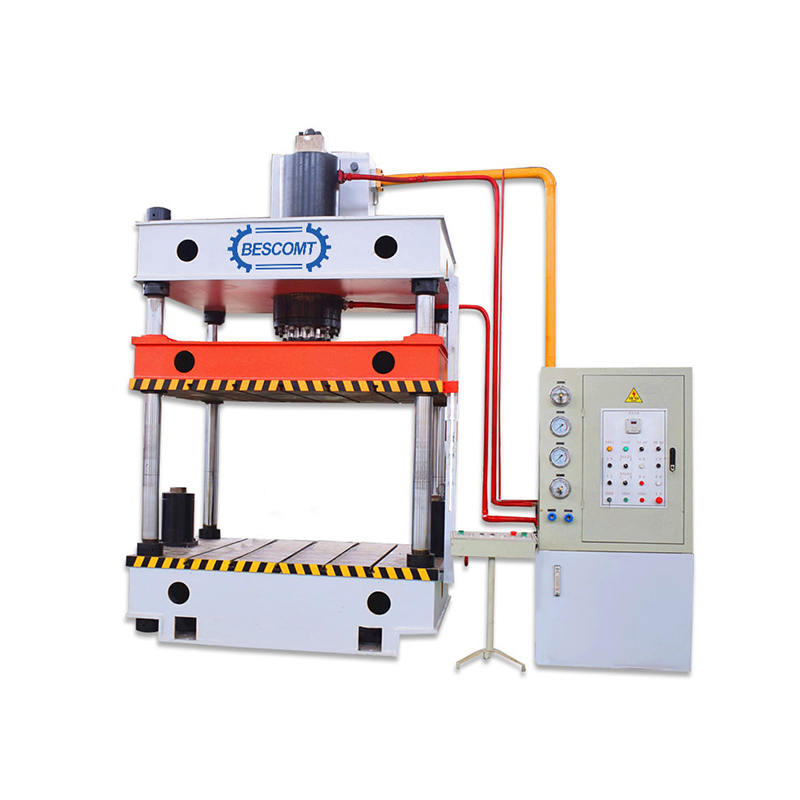
The architecture of the frame dictates the machine's capabilities and limitations. You must match the frame type to your specific operational requirements.
4-Pillar Presses: This design offers maximum rigidity. The four vertical columns guide the platen perfectly parallel to the bed. This configuration ensures even load distribution across the entire die surface. It exhibits minimal deflection, making it the only acceptable choice for high-precision tooling and complex coining operations.
H-Frame (Shop Press): The H-frame provides utility and versatility. It features an adjustable lower bed, allowing operators to accommodate parts of varying heights. This design excels in heavy-duty maintenance work, straightening bent shafts, and manual part positioning. It is the standard configuration for repair shops.
C-Frame: The C-frame, or gap-frame, features a distinctive open front. This design provides three-sided clearance around the tooling area. The open access is essential for high-speed, automated feeding systems. It allows raw material to enter from the side and finished parts to eject out the back. It is highly favored in stamping applications.
Frame Type |
Primary Advantage |
Best Suited For |
Deflection Rating |
|---|---|---|---|
4-Pillar |
Maximum rigidity and parallel guidance |
Deep drawing, precision coining, progressive dies |
Extremely Low |
H-Frame |
Adjustable bed height and versatility |
Maintenance, shaft straightening, bearing pressing |
Moderate |
C-Frame |
Three-sided open access |
Automated stamping, rapid part feeding |
Higher (Requires heavy gusseting) |
Actuation methods impact operator fatigue and production speed. Manual systems require physical exertion to build hydraulic pressure. Achieving the full 50-ton force manually often requires upwards of 75 lbs of pumping force on the handle. This level of exertion is acceptable for occasional maintenance tasks but completely unviable for repetitive production. Operator fatigue leads to inconsistent cycle times and increases the risk of workplace injuries.
Motorized, automatic systems eliminate operator strain and guarantee consistent cycle times. For a 50-ton machine, you must specify industrial-grade motor requirements. A standard configuration includes a 5HP, 415V, 3-phase, 1440 RPM flange-mounted motor. This power plant ensures the pump delivers sufficient flow for continuous duty cycles without overheating. Automatic actuation allows the operator to focus on part quality and safety rather than physical labor.
A genuine 50-ton output requires a specific mathematical relationship between the hydraulic cylinder bore size and the system pressure. You cannot achieve 50 tons of force with a small cylinder running at low pressure. A standard, reliable configuration utilizes a cylinder size of 250x160x600 mm operating at 175 bars of pressure. The surface area of the piston multiplied by the fluid pressure equals the total force.
You must warn your procurement team against deceptive manufacturing practices. Some builders over-pressurize undersized cylinders to claim a 50-ton capacity. Running a small cylinder at 250 bars or higher creates a dangerous system. High pressure generates excessive heat, blows out seals prematurely, and poses a severe safety risk to the operator. Always verify the bore size and maximum operating pressure before finalizing a purchase.
Physical dimensions dictate what parts you can process. The stroke length is the total distance the ram can travel. A 16-inch (300mm) stroke offers excellent versatility for most medium-sized operations. You must match the stroke specifications to your tallest tooling setups.
Daylight opening refers to the maximum distance between the bed and the ram when fully retracted. If your deep drawing operation requires a tall die and a long part extraction path, you need maximum daylight. Insufficient daylight makes it impossible to load the raw material or remove the finished component without damaging the tooling.
Hydraulic systems generate significant heat under load. The hydraulic reservoir acts as the primary thermal management system. A larger tank volume allows the fluid to rest and cool before cycling back through the pump. For a 50-ton machine, an 80-liter tank capacity provides adequate heat dissipation for standard operations.
Adequate fluid volume prevents hydraulic oil degradation. When oil overheats, its viscosity breaks down. Thin oil bypasses internal seals, causing a massive drop in pressing force. Continuous, multi-shift operations may require additional cooling systems, such as air-to-oil heat exchangers, to maintain optimal fluid temperature and prevent viscosity breakdown.
Specification Parameter |
Standard Requirement for 50-Ton Capacity |
Operational Impact |
|---|---|---|
Cylinder Bore Size |
250x160x600 mm |
Determines true force output at safe operating pressures. |
System Pressure |
175 Bars |
Prevents seal blowout and excessive heat generation. |
Motor Capacity |
5HP, 415V, 3-Phase, 1440 RPM |
Ensures continuous duty cycles without motor burnout. |
Reservoir Tank |
80 Liters Minimum |
Dissipates heat and prevents hydraulic fluid degradation. |
Stroke Length |
300 mm (16-inch) |
Accommodates deep drawing and automated part ejection. |
Procuring heavy machinery requires strict vendor evaluation. Selecting an unverified hydraulic press machine manufacturer exposes your facility to severe downtime risks. You must evaluate manufacturers based on their warranty terms and the domestic availability of replacement parts. Waiting weeks for imported valves, seals, or pumps halts production entirely. Establish clear service SLAs before signing any contract.
Demand comprehensive documentation. Request complete assembly instructions and exploded parts lists prior to purchase. Your internal maintenance team needs these documents to facilitate in-house troubleshooting and routine repairs. Insist on a Factory Acceptance Testing (FAT) protocol. You must witness the machine operating at full tonnage, either in person or via live video, before taking delivery. This ensures the equipment meets all specified parameters before it leaves the factory floor.
Operating a hydraulic press machine carries inherent physical risks. Mandatory safety integrations protect your workforce and ensure compliance with industrial regulations. You must install light curtains across the open access areas. These optical sensors instantly halt the ram if an operator reaches into the danger zone. Implement two-hand tie-down controls to force the operator to keep both hands away from the tooling during the downstroke. Hard-wired emergency stops must be easily accessible from multiple angles.
Hardware safety measures fail without proper operator training. Outline baseline training requirements for all personnel. Operators must understand the mechanics of the machine to prevent off-center loading. Placing a small part on the edge of the bed and applying 50 tons of force will bend the ram and shatter the tooling. Training prevents this costly negligence.
Every mechanical system degrades over time. Identifying critical wear points allows you to stock necessary replacement parts. Machined X-Y guide plates maintain ram alignment. These plates rely on replaceable wear pads. You must inspect these pads monthly and replace them when tolerances exceed manufacturer specifications. Cylinder seals represent another critical wear point. Keep a complete rebuild kit in your maintenance inventory.
Establish a strict preventative maintenance schedule. Hydraulic fluid filtration is paramount. Contaminated oil destroys pumps and scores cylinder walls. Replace the return line filters every 500 operating hours. Schedule regular pressure gauge calibration. A faulty gauge may indicate the machine is producing 50 tons when it is actually over-pressurizing the system to 70 tons, risking catastrophic structural failure.
Audit your heaviest tooling requirements and calculate the exact tonnage needed using the perimeter and shear strength formula.
Apply a strict 20% safety margin to your baseline tonnage calculation to prevent premature pump failure.
Request cycle-time simulations and comprehensive exploded parts lists from shortlisted vendors before issuing a purchase order.
Schedule a mandatory safety and operational training session for your floor staff prior to the machine's installation.
A: Maximum thickness depends entirely on the material's shear strength and the total perimeter of the punch. A 50-ton machine easily punches a 1-inch hole through 1/2-inch mild steel. For bending, it handles 1/2-inch steel plate across a standard V-die width, but exact limits require calculating specific tooling geometry.
A: Calculate the required force using the formula: Perimeter of cut × Material Thickness × Shear Strength. If the result exceeds 24 tons, you must select the 50-ton model. The 20% safety margin rule dictates that a 30-ton press should never operate continuously above 24 tons to prevent pump failure.
A: A standard bed size for this capacity is typically 700x400 mm. The bed features machined T-slots running parallel to the front of the machine. These slots accept standard heavy-duty clamping hardware, ensuring dies remain perfectly stationary under maximum load.
A: Achieving the full 50-ton output on a manual system typically requires approximately 75 lbs of downward force on the pump handle. This level of physical exertion makes manual presses suitable only for intermittent maintenance tasks, not for continuous daily production.
A: A standard press cannot perform high-speed stamping. To function as a stamping press, the machine requires specific upgrades. It needs fast up and down directional valving, a specialized high-flow pump, and an open C-frame design to accommodate automated material feeders.
A: Inspect hydraulic fluid levels and check for cylinder seal leaks weekly. Replace return line filters every 500 operating hours. Drain the reservoir, clean the internal suction strainers, and replace the hydraulic oil entirely every 2,000 operating hours or annually, depending on usage intensity.


