


Views: 0 Author: Site Editor Publish Time: 2026-11-23 Origin: Site


High-volume production relies on the execution of progressive dies. Pairing a highly engineered die with the wrong press guarantees premature tooling wear, excessive downtime, and destroyed profit margins. Selecting a press involves more than matching maximum tonnage. Decision-makers must account for off-center loading, frame deflection, snap-through shock, material yield strengths, and the integration of coil-feeding automation to ensure continuous, reliable output. A mismatched press tears itself apart over time, taking expensive tooling down in the process. This guide provides a technical evaluation framework for choosing the right metal stamping press. We compare drive types, analyze specifications, and outline strategies to mitigate implementation risks, ensuring your stamping operation achieves maximum long-term efficiency.
Frame Rigidity is Non-Negotiable: Progressive dies require straight-side press frames to minimize angular deflection and handle the off-center loads inherent in multi-station stamping.
Tonnage Distribution Matters: Total tonnage capacity must account for reverse tonnage (snap-through) and the specific force required at each station of the progressive die, not just a cumulative maximum.
Drive Type Dictates Capability: While a traditional mechanical stamping press offers high-speed consistency, servo-driven presses provide programmable stroke profiles that can extend die life and improve part quality.
Automation Readiness is Critical: A progressive die stamping press must seamlessly integrate with uncoilers, straighteners, and servo roll feeders to achieve true high-volume efficiency.
Progressive stamping feeds a continuous metal strip through multiple stations in a single press stroke. Each station performs a distinct operation, such as punching, coining, bending, or blanking. As the press cycles, the material advances. A finished part drops from the final station with every single stroke. This simultaneous execution demands a press capable of maintaining absolute precision under distributed dynamic loads. The carrier strip holds the parts together, and pilot pins align the strip at each station before the tooling engages.
You must justify the process against production volume. Progressive stamping requires a significant upfront investment in tooling compared to stage tooling or transfer press operations. However, once production crosses specific high-volume thresholds, a progressive die stamping press delivers the lowest per-part cost available in metal fabrication. The speed and continuous nature of the operation rapidly amortize the initial tooling expense. Transfer presses move individual blanks between stations using mechanical fingers, which limits operating speed. Progressive operations eliminate this transfer time, allowing for hundreds of strokes per minute.
Material constraints heavily dictate press selection. Modern manufacturing increasingly utilizes Advanced High-Strength Steels (AHSS), Dual Phase (DP) steels, and exotic alloys to reduce part weight while maintaining structural integrity. These materials possess exceptional yield strengths. They require significantly higher tonnage to shear and form. They also generate severe snap-through forces when the punch finally breaks through the material. Contrast this with deep drawn stamping, which handles hollow or complex geometries but operates at lower speeds and requires different press architectures to manage material flow.
Progressive dies demand specific press architecture. You need long bed sizes to physically accommodate multi-stage tooling. More importantly, you need precise slide guiding to maintain punch-to-die alignment across the entire length of the tool. Industry standards often dictate bed deflection limits of 0.0015 inches per foot of bed length under full load. If the ram shifts even a few thousandths of an inch during the stroke, the punches will clip the die matrix. You will experience chipped punches, out-of-tolerance parts, and die crashes that halt production for weeks.
Choosing the drive mechanism fundamentally alters how the press applies force and interacts with the material. You must align the drive type with your specific production requirements, material types, and part complexities.
A traditional mechanical stamping press relies on a large, heavy flywheel driven by an electric motor. The flywheel stores kinetic energy. When the control system engages the clutch, this energy transfers to the crankshaft, driving the ram downward. A brake stops the ram at the top of the stroke. Wet clutch systems run in an oil bath to dissipate heat, making them ideal for high-speed continuous tripping.
The primary advantages are speed and proven reliability. Mechanical presses achieve incredibly high strokes per minute (SPM). They represent a lower initial capital expenditure and feature straightforward maintenance protocols. However, they possess inherent limitations. The stroke length and velocity profile remain fixed. Furthermore, the maximum rated force is only available very near the bottom dead center (BDC) of the stroke. If you attempt to draw or form material too high up in the stroke, you risk stalling the press or damaging the drive train.
Servo presses eliminate the flywheel, clutch, and brake. Instead, they utilize direct-drive, high-torque servo motors connected directly to the drive shaft. The control system dictates the exact position, velocity, and acceleration of the ram at every millisecond of the stroke.
This technology provides distinct advantages. You gain fully programmable stroke profiles. You can program the ram to descend rapidly, slow down precisely as the punch contacts the material to reduce impact shock, dwell at BDC for complex forming or coining operations, and then retract quickly. Pendulum mode allows the ram to take short, rapid strokes without returning to top dead center, increasing output speeds. This flexibility drastically reduces snap-through shock, extends die life, and improves part quality. The main limitations are a higher upfront cost and the need for advanced operator training.
Hydraulic presses use fluid pressure to drive cylinders that move the ram. They deliver full tonnage throughout the entire stroke length. While excellent for deep drawing, they are generally unsuited for high-speed progressive die work. They simply cannot cycle fast enough to compete with mechanical or servo presses due to valve response times and fluid dynamics. Additionally, hydraulic systems struggle to absorb the sudden breakthrough shock generated by high-speed punching operations. You should only consider a hydraulic metal stamping machine for highly specialized, low-speed progressive applications involving deep draws.
Drive Type |
Speed (SPM) |
Stroke Profile |
Best Application |
|---|---|---|---|
Mechanical |
Very High |
Fixed / Sinusoidal |
High-volume blanking, simple forming, shallow draws. |
Servo |
Medium to High |
Fully Programmable |
Complex forming, AHSS materials, operations requiring in-die tapping. |
Hydraulic |
Low |
Constant Velocity |
Deep drawing, low-volume specialized progressive work. |
You cannot select a press based on a single number. The technical specifications must align perfectly with the physical realities of your tooling and the metallurgical properties of your coil stock.
Calculating required force requires precision. You must calculate the cutting, forming, and stripping forces based on the material's shear strength, thickness, and the total perimeter of the cuts. The formula for cutting force is Length of Cut × Material Thickness × Shear Strength. Never size a press exactly to this calculated number. Always add a minimum 20% safety margin to account for material thickness variations and tool wear. Dull punches require significantly more force to shear metal.
Managing snap-through is equally critical. Reverse tonnage occurs the exact millisecond the punches break through the material. The press frame, previously stretching under pressure, violently snaps back to its original shape. This shockwave travels through the machine, destroying bearings and cracking frames over time. Evaluate the press's shock-absorption capabilities. Look for robust tie-rod construction, where heavy steel rods pre-load the frame in compression to counteract the stretching forces and absorb reverse shock. Hydraulic tie-rod nuts help maintain this critical pre-load.
The physical dimensions of the press must accommodate your tooling. Size the bolster plate and ram face to fully support the physical dimensions of your largest progressive dies. Overhanging dies cause localized deflection, destroying part tolerances.
Evaluate the maximum and minimum shut height. Shut height is the distance from the top of the bed to the bottom of the slide when the stroke is down and the adjustment is up. Ensure this dimension is compatible with your existing and future tooling inventories. Bolster plate rigidity is paramount. A thin bolster plate will deflect under the heavy stamping stations of a progressive die, causing the center of the tool to run lower than the edges. Specify thick, heavily ribbed bolster plates—often 6 to 8 inches thick—to prevent localized deflection.
You must balance clearance and speed. A longer stroke provides more physical clearance between the upper and lower die halves. This clearance is necessary for part ejection, scrap removal, and material feeding. However, a longer stroke physically takes more time to complete, which reduces the maximum strokes per minute.
Evaluate continuous versus single-stroke speeds. Progressive stamping relies on continuous running. Ensure the clutch and brake systems are rated for the heat generation associated with continuous, high-speed operation, rather than just intermittent single-stroking. Drawing operations also limit speed; the punch cannot strike the material faster than the metal can flow without tearing.
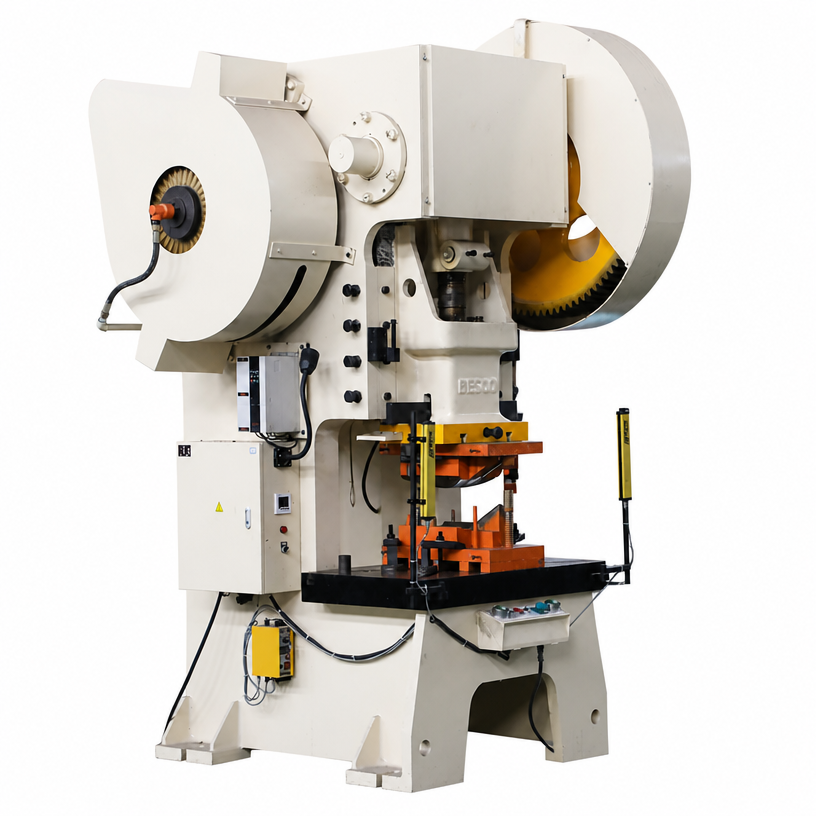
Make a definitive choice for straight-side presses in progressive applications. Straight-side frames feature four vertical columns supporting the crown and bed. They offer superior rigidity. Conversely, a C-frame punch press machine suffers from angular deflection, commonly called yawning. Under heavy loads, the open front of the C-frame bends backward. This yawning destroys the parallel alignment between the punch and die, leading to rapid tool wear and rejected parts.
Slide guiding systems maintain parallelism during off-center loading. Progressive dies rarely distribute tonnage evenly across the center of the ram. Heavy blanking might occur at one end, while light coining happens at the other. Compare 4-point versus 8-point gib guiding systems. An 8-point system captures the slide at all four corners, both front-to-back and left-to-right. This prevents the ram from twisting or tipping under off-center loads. Tight gib clearances, often set around 0.002 inches, keep the ram tracking perfectly straight.
Frame rigidity directly impacts bottom dead center (BDC) repeatability. If the frame flexes inconsistently, the punch will reach a different depth on every stroke. Absolute BDC accuracy is mandatory for maintaining tight part tolerances and minimizing quality control rejections during high-speed runs.
A press standing alone produces nothing. High-volume progressive stamping requires a synchronized ecosystem of auxiliary equipment to feed raw material and remove finished products.
The coil line ecosystem dictates your actual production throughput. Heavy coils of steel must be unwound by an uncoiler, flattened by a straightener to remove coil set, and pushed into the die by a feeder. Effective punch press automation requires seamless communication between all these components. A slack loop between the straightener and feeder provides a buffer of material, preventing the feeder from dragging the entire weight of the coil.
Synchronization is the most critical factor. The servo roll feeder must advance the material the exact progression distance while the press is open, and stop precisely before the pilot pins engage the strip. The feeder must also perform a pilot release—momentarily lifting its feed rolls—to allow the pilot pins to pull the strip into final alignment. Mis-timed feeds result in bent pilot pins, smashed tooling, and immediate production halts.
Continuous operation design requires efficient material evacuation. If scrap builds up inside the die, it will eventually obstruct the mechanism and cause a crash. Evaluate bed openings, scrap chutes, and under-bed conveyor integration. The press architecture must allow gravity to pull scrap away from the die area instantly. Shaker trays and scrap choppers help manage the volume of waste material generated at high speeds.
Integrate part ejection systems directly with the press control architecture. Air blow-offs and mechanical ejectors must actuate at specific degrees of the crank angle to ensure the finished part clears the die space before the ram descends for the next stroke. Programmable cam switches control these timing events with millisecond accuracy.
In-die sensing prevents catastrophic damage. You must integrate proximity sensors, short-feed sensors, and part-out sensors directly into the press control system. If a part fails to eject, or the material short-feeds, the sensor detects the fault instantly. Acoustic sensors can even detect the sound of a broken punch.
Utilize press-mounted sensors and vision systems for in-line quality control. These systems verify part dimensions and feature presence before the final cutoff station. This prevents you from running thousands of defective parts before an operator notices an issue.
Evaluate the stopping time of the machine. If a sensor detects a fault, the control system fires the brake. The clutch/brake response time must be fast enough to stop the ram before it closes on a misfed strip or a stuck part. A press that takes too long to stop renders die protection sensors useless.
Purchasing heavy machinery is a long-term partnership. The capabilities of the vendor are just as important as the iron they pour.
Assess whether the punch press manufacturer can provide and integrate the entire coil line and automation package, or if they just supply the bare press. Turnkey system integration eliminates finger-pointing between different equipment vendors when communication issues arise on the factory floor.
Evaluate their customization capabilities. Off-the-shelf presses rarely fit optimized production lines perfectly. The manufacturer must demonstrate the ability to customize bed sizes, window openings for material feeding, and control interfaces to match your specific operational requirements.
Downtime mitigation is critical for high-volume stamping. Every hour a press sits idle costs thousands of dollars. Evaluate the vendor's domestic parts inventory. If a critical bearing fails, you cannot wait six weeks for a replacement to ship overseas.
Investigate field service technician availability and remote diagnostic capabilities. Modern press controls allow factory engineers to log into the machine remotely, diagnose faults, and push software updates, drastically reducing the need for on-site service calls and getting you back in production faster.
Even the best equipment will fail if deployed incorrectly. Anticipate and mitigate these common implementation risks before the press arrives on your floor.
The most common risk in progressive stamping is placing heavy forming or blanking stations at the extreme ends of the die. This creates massive off-center loads. The ram acts like a lever, tipping under the uneven force. This damages the slide guides, wears out the bearings, and destroys the tooling alignment.
Mitigate this by requiring tonnage monitors on all new presses. These monitors measure the force exerted on each corner of the ram independently. Calculate the center of working forces for your dies and align that center with the centerline of the press. Evaluate presses with wide connection spacing and specify 8-point gibs to resist tipping forces.
High-speed progressive stamping generates severe dynamic forces. An improperly installed press will bounce on the floor. This vibration destroys part tolerances, cracks concrete floors, and damages adjacent precision machinery.
Mitigate this risk by conducting geotechnical surveys before installation to verify soil bearing capacity. Pour isolated press foundations separated from the main factory floor by expansion joints. Utilize engineered vibration-damping mounts or inertia blocks to isolate the high-frequency shockwaves generated during the stamping process.
Complex press controls and automated coil lines introduce significant operational hazards and steep learning curves. An untrained operator can crash a die or bypass critical safety systems in seconds.
Ensure the press meets current OSHA and ANSI B11.1 safety standards. Require light curtains, physical interlocks, and redundant safety valves. Use safety die blocks whenever operators reach into the die space. Mandate comprehensive vendor-led training programs for all operators and maintenance personnel before turning the machine over to production.
Audit your current and projected tooling inventory to determine maximum bed size, shut height, and off-center loading requirements.
Calculate the required tonnage for your toughest jobs, factoring in material shear strength, and add a mandatory 20% safety margin.
Evaluate your facility's foundation and soil bearing capacity to prepare for the dynamic loads and vibration damping required by high-speed operations.
Request capability studies and physical test runs from your shortlisted manufacturers using your actual progressive dies and coil stock.
A: A progressive press moves a continuous strip of metal through multiple stations, keeping the parts attached to the carrier strip until the final cutoff. A transfer press cuts the blank free at the first station and uses mechanical fingers to transfer the individual part from station to station.
A: Multiply the total perimeter of all cuts by the material thickness, then multiply that by the material's shear strength. Add the force required for any forming or bending stations. Finally, add a 20% safety margin to account for tool wear and material variation.
A: While possible for very light, low-tonnage applications, it is highly discouraged. C-frames suffer from angular deflection under load. This deflection misaligns the punch and die, causing rapid tool wear and poor part quality in multi-station progressive setups.
A: Advanced High-Strength Steels (AHSS) and thicker materials require significantly more tonnage to shear and form. More importantly, they generate severe reverse tonnage when the punch breaks through. This requires a highly rigid press frame and robust shock-absorption capabilities.
A: Snap-through is the violent release of stored energy in the press frame the exact moment a punch breaks through the material. This reverse shockwave travels through the machine, causing severe wear on bearings, tie-rods, and the frame itself if the press is not designed to absorb it.
A: Automation, including uncoilers, straighteners, and servo feeders, allows the press to run continuously at high speeds without manual intervention. This maximizes machine uptime, ensures precise material feeding to protect tooling, and drastically lowers the per-part labor cost.
A: Progressive dies often generate off-center loads because tonnage is rarely distributed evenly across the tool. An 8-point gib system captures the slide at all four corners, preventing the ram from twisting or tipping under these uneven loads, maintaining strict punch-to-die alignment.


