


Views: 0 Author: Site Editor Publish Time: 2026-10-07 Origin: Site


The industrial metal fabrication landscape has shifted heavily toward solid-state laser technology. Fiber lasers have largely replaced legacy CO2 systems on the shop floor. They deliver superior wall-plug efficiency and unmatched cutting speeds on thin-gauge materials. However, procurement teams and fabrication managers often face a steep learning curve. They struggle to align a machine's technical mechanics with specific production bottlenecks. Matching raw wattage, beam delivery mechanisms, and assist gas requirements to daily operations is difficult.
This confusion frequently leads to costly mistakes. Shops either over-spec a machine for simple jobs or buy under-performing equipment that chokes on heavy plate. This article breaks down the exact mechanics of fiber laser technology. It bridges the gap between complex machine physics, daily operator workflow, and operational return on investment. You will learn how to evaluate technical specifications objectively and choose the exact system your shop floor needs.
Solid-State Generation: Fiber lasers generate light within an active optical fiber doped with rare-earth elements, eliminating the need for fragile mirrors and laser gases used in legacy systems.
Instantaneous Thermal Reaction: The focused laser beam creates an immediate, high-temperature zone that instantly melts or vaporizes metal upon contact.
Power Dictates Capability: The choice between a 1000w and a 2000w fiber laser cutting machine directly impacts maximum material thickness, cutting speed, and edge quality.
Assist Gases are Critical: The cutting process relies heavily on assist gases (Nitrogen, Oxygen, or compressed air) to expel molten metal and dictate the chemical reaction at the cut zone.
Pump diodes serve as the initial power source. They emit intense, raw light directly into a heavily protected fiber optic cable. This cable acts as the active medium for laser generation. The core of this optical fiber undergoes a highly specialized doping process. Manufacturers typically use Ytterbium as the rare-earth element for metal cutting applications. As the pump light hits the Ytterbium atoms, it excites them. This excitation causes them to release photons. The doping amplifies the light to a specific wavelength of exactly 1.064 micrometers.
This specific wavelength matters immensely on the shop floor. Metals absorb 1.064-micron light significantly better than the 10.6-micron wavelength produced by older CO2 lasers. This solid-state generation contrasts sharply with legacy resonators. You do not deal with fragile glass tubes. There are no internal mirrors to align. You never need to mix expensive laser resonator gases. This rugged design drastically reduces moving parts. It eliminates hundreds of hours of routine maintenance.
Feature |
Fiber Laser Technology |
Legacy CO2 Technology |
|---|---|---|
Wavelength |
1.064 micrometers |
10.6 micrometers |
Beam Delivery |
Flexible fiber optic cable |
Complex mirror flight path |
Maintenance |
Minimal moving parts |
High maintenance (mirrors, gas mixes) |
Metal Absorption |
High absorption rate |
Lower absorption rate |
Once generated, the concentrated light travels through a transport fiber. This fiber transmits the beam directly from the power source to the cutting head. It does this over long distances without any noticeable power loss or beam degradation. The operational advantage here is massive for heavy industry. You get a completely sealed, flexible delivery system. It remains entirely immune to environmental contamination.
Airborne dust, grinding grit, and heavy machine vibrations are constant threats in fabrication shops. A fiber delivery system ignores these hazards entirely. It keeps the beam pristine from the generator to the material surface. This ensures consistent cutting performance shift after shift. There are no bellows to purge. There are no external flight path mirrors to clean. Operators spend their time cutting metal instead of aligning optics.
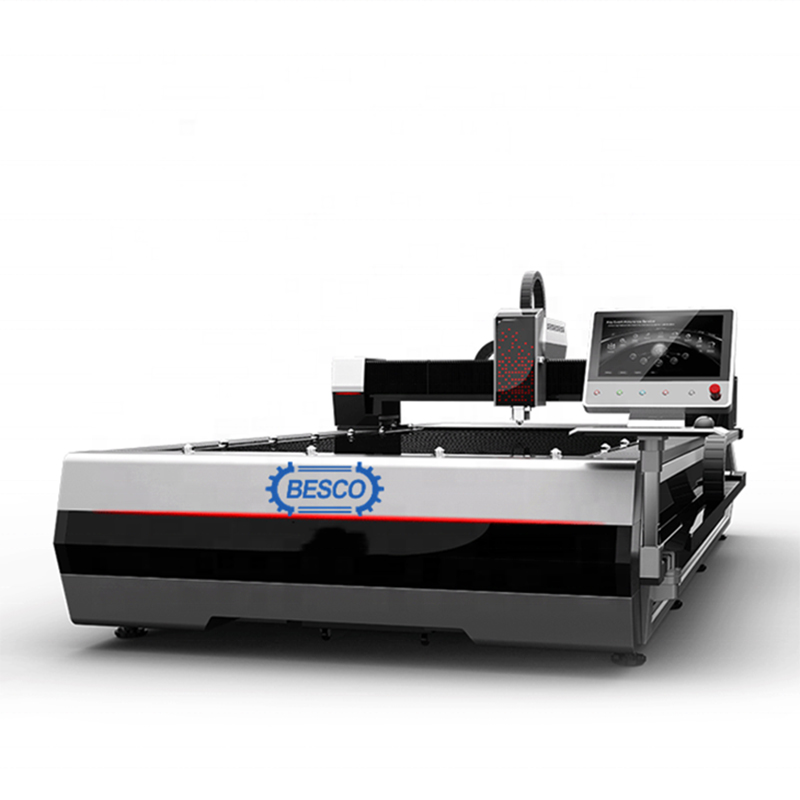
The cutting head acts as the physical execution point of the entire system. First, the diverging light exiting the transport fiber enters the collimation unit. This lens arrangement takes the spreading light rays and makes them perfectly parallel. Next, the beam passes through a focusing lens mechanism. This lens concentrates the parallel beam into a microscopic, high-intensity focal point right on the material surface.
This concentrated energy density generates the extreme temperatures required to instantly melt or vaporize carbon steel, stainless alloys, or aluminum. Modern cutting heads feature advanced auto-focus capabilities. This is an essential evaluation feature for any high-production facility. It allows the machine to adjust the focal point dynamically. Operators can process varying material thicknesses back-to-back without stopping production for manual lens adjustments. Additionally, capacitive height sensors in the head maintain an exact standoff distance from the metal surface. This prevents head crashes on warped plates.
Inside the cutting head, protective windows shield the expensive focusing optics from spatter and dust. Replacing these windows is a standard maintenance task. Keeping them clean prevents thermal blooming. Thermal blooming occurs when dirt absorbs laser energy, heats up, and distorts the focal point, leading to terrible cut quality.
The cutting head mounts to a highly mobile, rigid mechanical system. Machine builders utilize heavy-duty gantry frames driven by rack and pinion systems or advanced linear motors. These drive components provide an incredible degree of precision movement at high speeds. They dictate the machine's overall positioning accuracy and repeatability.
The CNC software acts as the central nervous system. It synchronizes beam power, pulse frequency, and multi-axis movement in real-time. This precise synchronization prevents thermal distortion. When cutting complex geometries, sharp corners, or intricate hole patterns, the CNC automatically ramps down the laser power as the cutting head decelerates. This prevents the metal from warping, burning, or melting out of tolerance.
A robust frame absorbs the inertia of rapid directional changes. If the frame lacks rigidity, the cutting head will vibrate during high-speed maneuvers. This vibration translates directly into jagged cut edges and rejected parts. Heavy steel weldments and cast iron gantries provide the necessary dampening for high-speed operations.
Assist gas performs a vital mechanical and chemical function at the cut zone. It blows away the molten or vaporized metal from the kerf immediately after the laser makes contact. Without high-pressure gas, the molten metal would simply weld itself back together as it cools. Different gases create entirely different reactions based on the material.
Exothermic cutting utilizes Oxygen. The oxygen reacts chemically with the carbon in mild steel. This creates extra heat that helps slice through thicker plates efficiently. Melt-and-blow cutting utilizes Nitrogen. This method is the industry standard for achieving clean, oxidation-free edges on stainless steel and aluminum. The nitrogen acts as an inert shield. It prevents the hot metal from reacting with ambient air.
Identify the material type and thickness on the daily job traveler.
Determine the required edge quality for downstream processes like welding or powder coating.
Select Oxygen for thick carbon steel to maximize cutting speed and penetration.
Select Nitrogen for stainless steel and aluminum to prevent edge oxidation and eliminate secondary grinding.
Adjust the gas pressure at the CNC interface based on the installed nozzle diameter.
Operating a fiber laser cutting machine begins entirely in the digital realm. Engineers and designers create flat patterns in CAD software. They then import these DXF or DWG files into dedicated CAM software to generate the actual CNC code. This code dictates every rapid movement, pierce point, and cutting path.
Advanced nesting algorithms play a massive role in shop profitability. The software arranges the parts as tightly as possible on the digital sheet. It calculates kerf widths, shared cut lines, and grain direction. Common line cutting is a specific strategy where two parts share a single cut path. This reduces overall cutting time and saves assist gas. The software automatically applies kerf compensation to ensure final part dimensions are perfectly accurate. It also places micro-joints to keep small parts from tipping up and colliding with the cutting head. This maximizes material yield and significantly reduces expensive scrap rates during daily operation.
The machine operator takes the generated program and prepares the physical equipment. They select pre-programmed cutting parameters from the machine's database based on the specific material type and thickness. Modern touchscreen interfaces simplify this setup dramatically. They make it easy to adjust focal length, gas pressure, and cutting speed on the fly.
Before running a full sheet, operators perform nozzle centering routines. They execute tape shots to ensure the beam aligns perfectly with the nozzle orifice. This intuitive control and automated calibration reduce the learning curve for new operators. It helps fabrication shops maintain high throughput and strict quality control even when relying on less experienced staff.
Daily Operator Task |
Purpose |
Frequency |
|---|---|---|
Nozzle Centering |
Ensures the beam exits the exact center of the nozzle for straight cuts. |
Every nozzle change |
Protective Window Inspection |
Checks for dust or spatter that could cause thermal blooming. |
Start of every shift |
Chiller Temperature Check |
Verifies the cooling system is maintaining optimal laser source temperature. |
Start of every shift |
Scrap Drawer Emptying |
Prevents slag buildup from interfering with the shuttle table movement. |
End of every shift |
Raw power dictates your facility's capability on the shop floor. A 1000w fiber laser cutting machine provides a highly reliable baseline for many entry-level or specialized shops. It is highly optimal for processing thin-gauge sheet metal. You can reliably cut carbon steel up to 4-6mm thick with excellent edge quality.
However, stepping up the wattage changes the production math entirely. A 2000w fiber laser cutting machine processes much thicker plates. It handles material up to 12-16mm with ease. Furthermore, the extra wattage maintains significantly higher feed rates on thinner materials. A 2000W system can cut 2mm steel nearly twice as fast as a 1000W system. This drastically boosts overall production capacity and lowers the cost per part.
Laser power and cutting speed do not share a perfectly linear relationship. Pushing higher wattage definitely allows for faster processing, but it introduces new variables. Running at maximum speed requires precise thermal management. If the machine moves too fast without adequate assist gas flow, you risk heavy dross accumulation on the bottom edge of the cut.
You might also cause severe edge burning on intricate parts where heat builds up quickly. Balancing raw speed with acceptable edge quality is a daily operational necessity. Operators must constantly tweak feed rates, focal positions, and gas pressures to find the sweet spot for each specific batch of material.
When cutting sharp corners, the machine must decelerate. If the laser power remains at maximum during this deceleration, the corner will melt away. Modern controllers automatically modulate the power output to match the actual travel speed, preserving sharp geometry and preventing blowouts on intricate designs.
Cutting stainless steel requires a specific mechanical approach. A dedicated stainless steel laser cutting machine relies heavily on high-pressure, high-purity Nitrogen. This gas physically ejects the molten material while preventing oxidation during the cut. It leaves a clean, silver, weld-ready edge that requires zero secondary grinding.
The focal position must be set perfectly. It is usually placed deep inside the material thickness to ensure a clean blowout. The nozzle diameter also heavily impacts the gas flow dynamics. Using a nozzle that is too small restricts flow and causes burrs. A nozzle that is too large wastes expensive nitrogen. Getting these settings right ensures the cut quality meets strict food-grade or medical industry standards.
Historically, back-reflection destroyed laser oscillators. Cutting reflective metals like copper or brass was a massive, expensive risk. The laser light would bounce off the shiny material, travel backward through the delivery system, and fry the internal components.
Modern fiber laser architecture solves this problem permanently. The systems now feature built-in optical isolators that absorb or safely deflect back-reflected light. This built-in protection makes a fiber laser metal cutting machine the superior choice for processing highly reflective non-ferrous metals. You can cut aluminum, brass, and copper at high speeds without any fear of damaging the core equipment. This opens up new revenue streams for your fabrication business.
Evaluating metal laser cutting equipment requires a strict focus on hourly operating expenses. You must calculate the wall-plug efficiency to determine your actual electricity usage under load. Fiber systems draw significantly less power than older technologies, dropping utility bills. Assist gas consumption rates heavily impact your bottom line, especially when cutting with high-pressure nitrogen.
You also need to track consumable lifespan rigorously. Copper nozzles take abuse from spatter and require frequent replacement. Protective windows inside the cutting head eventually degrade from microscopic dust and need swapping. Knowing these exact numbers helps you project accurate, real-world running expenses.
Installing new equipment requires serious facility planning and infrastructure upgrades. You must account for the massive physical footprint of the machine and its loading tables. The system needs dedicated industrial chillers to manage the heat generated by the laser source and cutting head. These chillers require regular fluid checks and condenser cleaning to prevent overheating.
High-capacity fume extraction systems are mandatory to maintain operator safety and indoor air quality. The machine itself requires a Class 1 safety enclosure with specialized laser-safe viewing windows. Do not underestimate gas supply logistics. High-volume cutting often demands the installation of permanent bulk tanks rather than swapping out liquid dewars every few days, which disrupts production.
Choosing the right equipment partner dictates your long-term success. When vetting an industrial laser cutting machine supplier, look far beyond the initial sale. Check their local parts availability and warehouse locations. Demand clear technician response times and strict service level agreements.
Ensure they include comprehensive operator and maintenance training at your facility. Always request custom time-studies and sample cuts on your specific materials. Never rely solely on generic specification sheets or showroom demonstrations to make a capital equipment decision of this magnitude.
Audit your current cutting expenses to identify exact production bottlenecks and material waste.
Define your required production tolerances and edge quality standards before reviewing machine specifications.
Map your primary material types and maximum thicknesses to determine the exact wattage required for your shop.
Submit your own difficult material samples to a vetted supplier for a real-world test cut to verify edge quality.
A: It generates a 1.064-micron wavelength beam via rare-earth doped optical fibers. This intense beam travels through a flexible transport cable and focuses through precision optics to instantly melt or vaporize metal. High-pressure assist gas then rapidly clears the molten material from the kerf to create a clean cut.
A: The workflow starts by importing digital CAD files into nesting software to maximize material yield. The operator then selects material-specific parameters on the CNC interface. Finally, they align the raw sheet metal, verify nozzle centering and gas pressures, and initiate the automated cutting sequence.
A: A 1000W system is highly optimized for thin-gauge materials. It can reliably cut carbon steel up to 6mm thick. However, it struggles significantly with edge quality, dross accumulation, and cutting speed on plates thicker than 6mm, making higher wattages necessary for heavy plate work.
A: Nitrogen acts as a high-pressure, inert shielding gas. It physically blows away the molten metal while completely preventing oxidation during the extreme melting process. This leaves a clean, silver edge that requires zero secondary grinding or chemical cleaning before welding.
A: Modern fiber lasers feature robust, built-in back-reflection isolators. These optical isolators absorb or safely deflect returning light. This protects the sensitive oscillator from catastrophic damage when cutting highly reflective metals like copper, brass, and polished aluminum.
A: Prioritize comprehensive post-sale support. Look for a supplier with a robust, localized OEM parts inventory, reliable preventative maintenance contracts, and in-depth software training. Fast technician response times are absolutely critical to minimizing expensive machine downtime.
A: Protective lenses typically last several weeks to a few months, depending on the cutting environment and material spatter. Copper nozzles may need replacement every few days or weeks. Material type, gas pressure, and operator skill heavily impact these wear rates.


