Views: 0 Author: Site Editor Publish Time: 2026-06-29 Origin: Site
Procurement managers and shop owners face a constant dilemma on the factory floor. They must routinely balance raw production speed against necessary forming versatility. At a baseline level, both machine types deform metal into desired shapes. However, their specific methods of force delivery dictate highly specific use cases. Choosing incorrectly often leads to severe production bottlenecks. It can also cause premature tooling failure. Our goal is to move past basic definitions. We provide a hard-numbers, application-first evaluation framework. This guide will help you confidently choose the right equipment for your operations. You will discover exactly how machine mechanics impact cycle times, facility footprint, and operator safety. Armed with this knowledge, you can make procurement decisions based on yield strength requirements and production volume.
Force Delivery: Hydraulic presses deliver full tonnage throughout the entire stroke, ideal for deep drawing; mechanical punch presses reach peak tonnage only at the bottom of the stroke, ideal for rapid blanking.
Production Volume: Punch press machines dominate high-volume, repetitive stamping runs due to vastly superior cycle speeds.
Flexibility & Setup: Hydraulic presses offer superior versatility for variable material thicknesses and rapid tooling changes.
Safety & Overload: Hydraulic systems feature built-in overload protection, significantly reducing the risk of catastrophic die damage compared to mechanical presses.
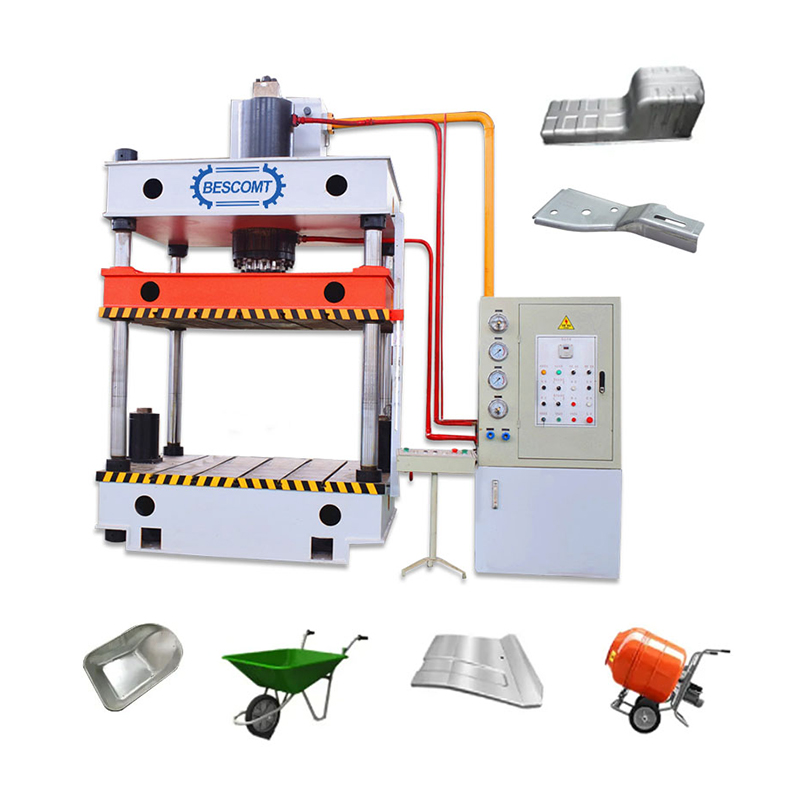
A hydraulic press machine operates using pressurized hydraulic fluid driving internal cylinders. This design relies on Pascal’s principle to generate immense compressive force. Operators can accurately program this force for diverse applications. The defining outcome of this mechanism is consistent power delivery. The machine delivers its maximum programmed force at any point during the stroke.
This method offers distinct control advantages. Operators can adjust stroke depth, ram speed, and pressure on the fly. You can even program the ram to dwell at the bottom of a stroke. This dwell time proves critical when setting adhesives or allowing materials to settle during complex molding. Unlike mechanical alternatives, hydraulic systems never suffer from mid-stroke tonnage drop-off.
A mechanical punch press operates on an entirely different physical principle. It uses a heavy, motor-driven flywheel connected to a clutch and crankshaft mechanism. The motor spins the flywheel to build massive kinetic energy. When the operator engages the clutch, the system translates this rotational energy into a rapid downward stroke. This creates a high-impact force designed to shear metal instantly.
This design comes with a strict control limitation. Tonnage output strictly ties to the stroke position. A punch press machine achieves its rated tonnage only at Bottom Dead Center (BDC). It cannot adjust pressure mid-cycle. If your material requires maximum force before the ram reaches the very bottom, a mechanical press will stall. Engineers refer to this stalling as "locking on the bottom." Freeing a locked mechanical press requires significant downtime and effort.
Many new shop owners assume tonnage is universal across machine types. They attempt to use a 50-ton mechanical press for an application requiring 50 tons of force early in the stroke. The machine will stall because it only generates 50 tons at the absolute bottom of the cycle.
Mechanical punch presses excel at high-speed blanking and piercing tasks. Their rapid cycle times make them the undisputed choice for high-volume, flat-sheet punching. A mechanical press can easily perform hundreds of strokes per minute. It effortlessly punches identical shapes out of continuous metal coils. If your production run demands tens of thousands of basic washers or brackets, mechanical speed wins every time.
However, this speed brings limitations. Mechanical presses are entirely unsuitable for parts requiring deep, slow material flow. The violent impact speed will tear the material rather than stretch it. You cannot effectively use them for deep cupping or complex drawing operations.
Hydraulic systems excel at deep drawing, heavy forming, and coining. Slower, controlled material deformation prevents tearing in complex forming operations. It also heavily reduces work-hardening in the metal structure. When forming deep pots, pans, or automotive panels, the material must stretch evenly. The constant force and adjustable speed of hydraulic rams allow perfect material flow.
Consider the versatility factor when comparing a hydraulic press machine vs punch press. Hydraulic equipment allows shops to run multiple operations safely. For instance, you can adapt standard punch dies for use in a small-shop 20-ton hydraulic press. While the cycle time slows down, you gain massive flexibility without risking a catastrophic machine lockup.
The type of force delivery directly impacts your tooling budget. The violent shock of a mechanical press accelerates die wear. The constant impact fractures delicate punch tooling over time. Shops running mechanical machines must budget for frequent die sharpening and replacement.
Hydraulic presses offer a distinct advantage here. The "soft touch" of a hydraulic ram extends die life significantly. It eases the tool into the material rather than slamming into it. This controlled entry allows for easier integration of custom or delicate tooling. Many shops switch to fluid-powered machines simply to protect their expensive, custom-machined dies.
Operational Capability | Hydraulic Press Advantage | Mechanical Punch Press Advantage |
|---|---|---|
Cycle Speed | Slower, ideal for delicate, deep forming. | Extremely fast, perfect for high-volume blanking. |
Force Availability | Full tonnage available anywhere in the stroke. | Full tonnage only available at Bottom Dead Center (BDC). |
Stroke Control | Highly adjustable speed, depth, and pressure. | Fixed stroke based on crankshaft design. |
Die Preservation | Soft contact reduces shock and extends die life. | High impact increases wear on delicate tooling components. |
Machine safety remains a top priority for plant managers. Hydraulic systems feature built-in overload protection by design. If the ram encounters resistance exceeding its maximum pressure rating, the fluid simply bypasses a relief valve. The ram safely stops moving. This inherent protection prevents catastrophic machine damage. It also protects the die from shattering under unexpected stress.
Mechanical presses lack this fluid-based relief. Mechanical jamming presents a constant risk, particularly from double-feeding material. If an operator accidentally feeds two metal sheets into a mechanical press, the kinetic energy has nowhere to go. The machine will attempt to force the cycle, resulting in a locked ram, shattered dies, or a broken crankshaft. Clearing a stuck mechanical ram requires specialized maintenance teams and results in costly downtime.
Always enforce the use of light curtains on both machine types to prevent hands from entering the pinch zone.
Mandate two-hand tie-down controls so operators must keep both hands clear during the downstroke.
Regularly inspect hydraulic relief valves to ensure they bypass fluid at the correct pressure thresholds.
Install mechanical tonnage monitors on punch presses to detect double-feed scenarios instantly.
Facility layout often dictates machine selection, especially in the "small shop" scenario. Hydraulic presses generally boast a smaller footprint per ton of force. A 100-ton hydraulic unit takes up significantly less floor space than a 100-ton mechanical unit. Furthermore, fluid-powered machines operate much quieter. They eliminate the deafening percussive impact associated with heavy mechanical stamping.
Heavy mechanical machines demand robust infrastructure. Large punch presses often require specialized, reinforced concrete foundations. These foundations must absorb the severe vibration generated by the flywheel and the impact stroke. Without proper foundation isolation, a heavy mechanical press will literally shake a facility apart, damaging nearby sensitive equipment. Hydraulic machines rarely require deep foundation work because they generate minimal vibration.
Mechanical machines belong in specific production environments. You should lean toward mechanical equipment if your business model relies on speed and repetition. Evaluate your floor operations against these criteria:
Your primary operations consist of blanking, piercing, or shallow stamping.
Production runs regularly exceed 10,000 units requiring rapid turnaround times.
Material thickness remains completely consistent across your production runs.
Your facility has the reinforced foundation necessary to handle heavy kinetic vibrations.
Hydraulic equipment serves versatile, high-mix environments perfectly. These machines adapt to changing projects quickly. You should specify fluid-powered equipment if your daily operations look like this:
Your operations require deep drawing, structural straightening, or complex molding.
You run high-mix, low-to-medium volume production schedules.
You frequently change dies and require infinitely variable stroke lengths.
You operate in a smaller facility lacking reinforced concrete machine pits.
Choosing your next machine requires structured planning. Never buy a machine based solely on its theoretical tonnage. Follow these actionable steps to ensure proper equipment matching:
Audit current tooling compatibility: Measure the shut height and bed dimensions of your existing dies. Ensure your new machine can accommodate them.
Calculate actual material requirements: Do not rely on historical machine size. Determine exact force needs based on material shear strength and thickness.
Consult the experts: Reach out to a qualified metal forming equipment supplier. They can run tonnage calculations and recommend the precise setup for your yield strength parameters.
Neither machine type is universally superior in the metal forming industry. The correct choice hinges entirely on your specific application needs. You must weigh the raw speed of mechanical blanking against the controlled force of hydraulic forming. Always prioritize your most profitable and frequent production runs when making this evaluation. If you primarily stamp thousands of flat washers daily, embrace mechanical speed. If your highest margins come from complex, deep-drawn aerospace components, you need fluid power.
We encourage buyers to step back and look at their long-term facility goals. Consider how stroke mechanics impact your tooling life and floor space. Take the guesswork out of your next major capital purchase. Request a detailed engineering consultation or a custom tonnage calculation from a trusted manufacturer today.
A: Yes, standard punch dies can often be adapted for use in hydraulic presses. This interchangeability makes them highly versatile for smaller shops handling mixed jobs. However, you must account for production speed. The cycle time on a fluid-powered machine will be noticeably slower than on a mechanical punch press.
A: You can calculate baseline tonnage using this formula concept: shear strength of the material multiplied by material thickness, multiplied by the perimeter of the cut. Hydraulic presses safely deliver maximum rated tonnage anywhere in the stroke. Mechanical presses only deliver full tonnage at the absolute bottom.
A: From an equipment standpoint, hydraulic systems feature inherent overload relief valves. These valves bypass fluid to prevent machine-breaking jams. Mechanical presses lack this and can suffer catastrophic damage from double-feeding. However, both machine types require strict adherence to light curtains, two-hand tie-downs, and OSHA compliance for operator safety.